Martes, Setyembre 3, 2013

Film Noir


I really had no idea what to write about on this one because I was absent when they watched the documentary Film Noir but I will just post here the facts that I got about it, over the internet. T__T

Film noir comes from the french that means "black film". Most of the films are about crime and sex in general. It was inspired by German Expressionist films that uses dark background and the topics are also about crimes. 

This film movement started in the 1940's and ended at the late 40's. 
There are two important elements in a Film Noir, one is the chiascuro lighting, it is the use of lights and shadows dramatically and the femme fatale, the female in the film that will seduce the protagonist that will cause the protagonist to his fall.
Femme Fatale
Some of the well acclaimed Film Noir movies are, Double Indemnity, The Big Sleep, The Maltese falcon and Laura. 

I found a copy of A foreign affair, 1948, you can watch it here! :)


That's all folks for today. :D It is hard to be absent in a 3 hour class, for you will miss too many good lessons. 

- KC

The New Hollywood and Independent Filmmaking


Like what I said in my previous blog post here. Hollywood lost its reign in the 1960's though some movies were successful like The Sound of Music and Dr. Zhivago. Most of the studios in Hollywood begun to go down, we have seen it in the documentary that the studios were literally been taken down.

Some producers produced movies that are still taboo at that time and somehow it worked but did not last.  (Dennis Hopper’s Easy Rider, and Robert Altman’s M*A*S*H) At that time, film school graduates started to create a noise in the movie industry like George Lucas, Martin Scorsese, Francis Ford Coppola, Steven Spielberg, Brian De Palma. They did not undergo the traditional studio system but they studied film in Film Schools at New York University, the University of Southern California, and the University of California at Los Angeles. 

the "movie brats"
The so called "movie brats" made films that were influenced by the classical Hollywood style and some European filmmakers. They also incorporated their stories in their films like, American Graffiti was not only a teenage musical but also Lucas's reflection on growing up in California in the 1960s. Martin Scorsese drew on his youth in New York's Little Italy for his crime drama Mean Streets (1973;12.49). Coppola
imbued both Godfather films with a vivacious and melancholy sense of the intense bonds within the Italian American family. Paul Schrader poured his own obsessions with violence and sexuality into his scripts for Taxi Driver and Raging Bull and the films he directed, such as Hard Core (1919).The seamless storytelling was still present at their movies. 

Some foreign directors were also known at that era, as well as some American-African and Asian-American directors. There were also women directors that penetrated the movie industry.  
Allison Anders, female director
There was no specific movement at the 1970's up to now, there are directors who stayed doing the medium-cost films and some directors went to studios for high-cost films.

- KC

French Impressionism And Surrealism

Hi again! So here are my notes about French Impressionism and surrealism. By the way, I found a hard time searching for the page of the article in the book because I was following the pages in Adobe reader, just sharing haha.

Impressionism

This film movement started when the World War I began to struck the movie industry in France. There were only two film firms at that time and exporting of movies was stopped. They can't produce their own movies so that they imported so many Hollywood films to the point that the are Hollywood films are more known than the French films. Then the young directors such as, Abel Gance, Louis Delluc, Gernraine Dulac, Marcel L'Herbier, and Jean Epstein started to make films that are not for commercial's sake but for art's sake and they penetrated to the French film industry.

Impressionism is more about the inner thoughts and the psychological processes that is happening to every person in the film. Flashback were common to suggest that a person in the film is thinking about the his/her past. Thinking of one's dreams, fantasies and mental states was also prevalent. Emotion is the center and the backbone of Impressionist films.

The impressionist also spearheaded the use of pronounced rhythm editing to their films. When the action comes to a violent or emotional turmoil the rhythm is faster and the shots will be shorter and shorter but when the reaching the climax it will be longer. They also used point-of-view shots heavily.
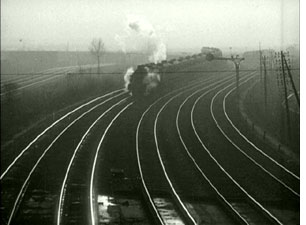
La Roue's train scene
The movement came to end on 1929 because the French masses seems to like sound films more and only elites were the ones who appreciate it due to its formality. But many filmmakers were influenced by the French Impressionism such as Alfred Hitchcock.

Surrealism

Out of this world. Anti-narrative.

This are just few descriptions that I can say about surrealism. According to the book, the surrealist relied mo on private showing rather that on commercial film industry. Surrealism was heavily influenced by the surrealist  literature and paintings, which are out of this world too, dreamlike.

If I were to compare it to Impressionism, they are exactly opposites because Impressionism is more about the logical thinking of a person in the film and surrealism provides no logic at all.

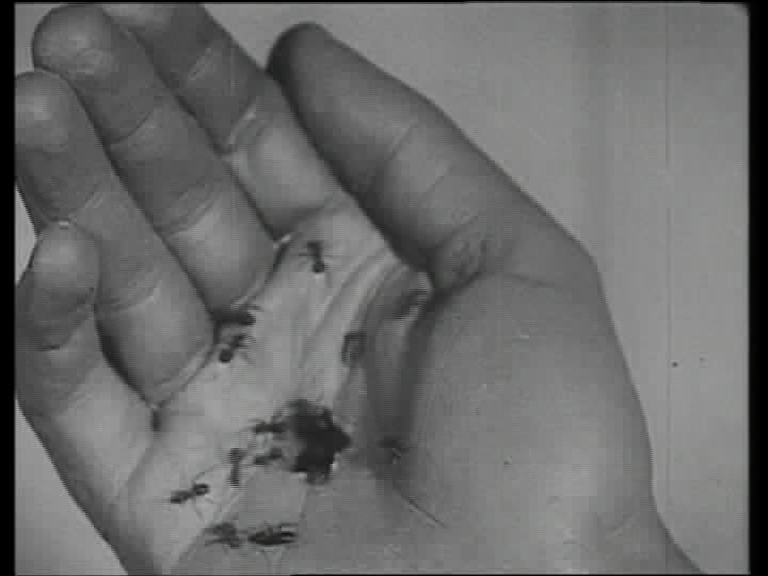
Surrealism distorts causality because a specific action can be done in the film without any logical reason behind it. One good example of this is, in the film Un Chien Andalou, flies come out of the hands of a man.
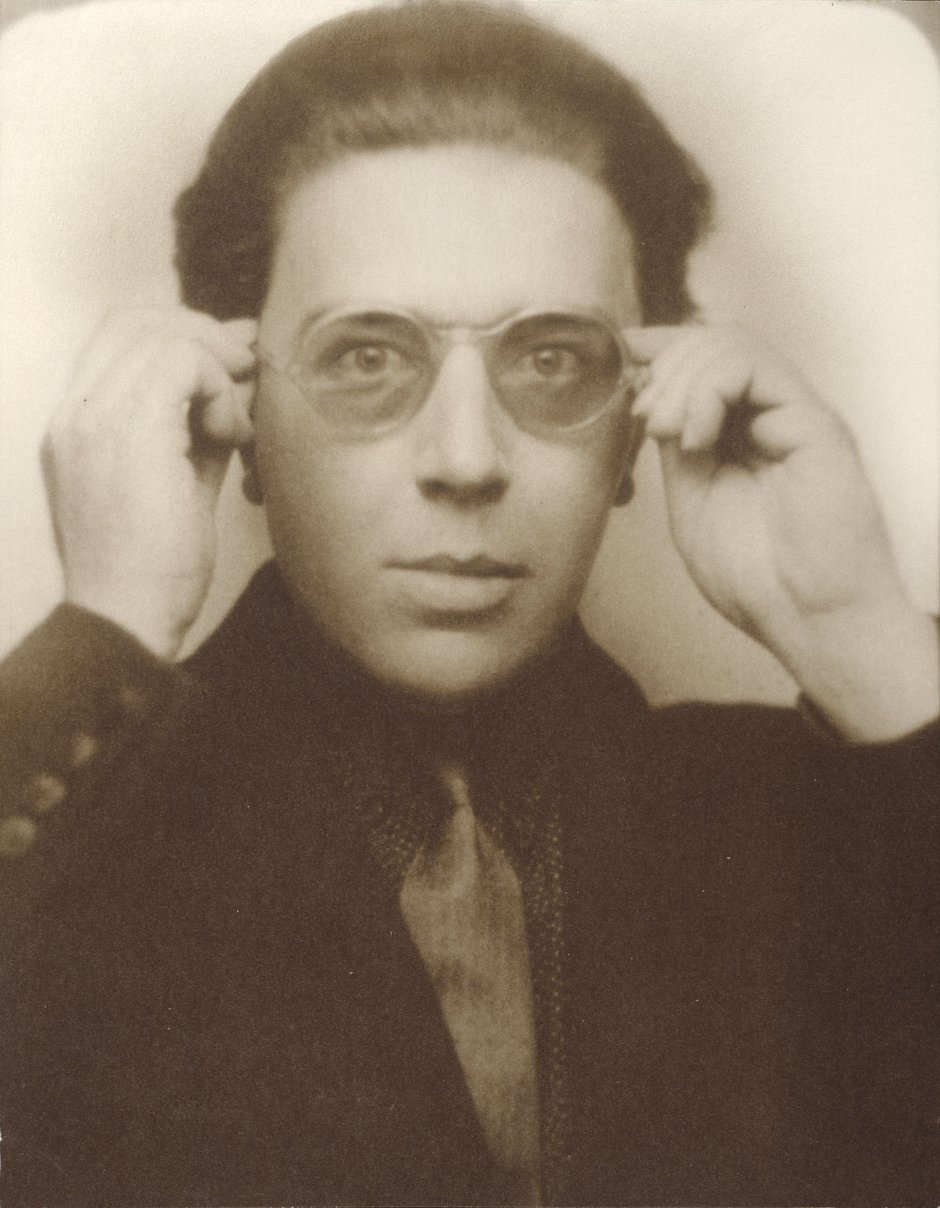
Anton Breton
When the spokesperson of Surrealism, Anton Breton joined a communist party in 1929, the surrealism movement also went down.

Hope that you learned new things about these two film movements today! :)

-KC

Film School Generation

The Classical Hollywood lost its reign in the early 1960's because of the advent of television and the Americans wanted a new treatment to films. And that's when the young directors of the generation found its way into the mainstream film industry. 

Our professor raised the question that we needed to answer at the end of the documentary. Who are the directors that pleases the audience? Who are the directors that pleases himself?

Coppola-Spielberg-Scorsese-Lucas
From what I have watched only Brian de Palma and Steven Spielberg really cared about their audiences and most of the directors of the generation really wanted to showcase what they want and apparently it is also the wants of the movie-goers at that time. Sex, drugs and all of the taboos of that generation, were evident to the movies that they did in the early 60's up to when they started to go back to the studios which is the early to late 70's.

The reign of these filmmakers came to an end when they started to produced movies that are high cost. And they don't have the money to produce such movies so they went back to the studios and somehow the studios have the capability to control the directors again. 

The film school generation directors also were the first to have blockbuster movies, Jaws, Star Wars are a sample of blockbuster movies. 

At the end of the documentary, they showed the directors who are still in the movie industry and sadly only few of them lasted. 

-KC

Un Chien Andalou : A Movie Review


We watched a surrealist movie called Un Chien Andalou that was directed by Luis Bunuel and Salvador Dali. I must say, it was really a weird film. I tried my best to comprehend the film but in the end you will be lost because it is very complex and sometimes illogical. Example, how can flies come out from a person's hand? Also, how can a man pull two grand piano with two persons (I guess they are the pianist) in it? The person must have a very strong body to do that, but apparently in the movie, he's not. 


It was hard for me to understand the story because like in a dream, a certain think that was done in the movie doesn't have to have a specific reason for the act to be accomplished. The sequences of the film were not connected for me. There is only one time, ONE TIME in the film that i somehow understood it, it was when the lead actor was lying down on his bed wearing some baby clothes, and then a man came in to his room, the exact copy of that guy and he started to remove the baby clothes of that guy and he threw it outside of the window, maybe it means that he is reminding himself to grow up and mature. 

In the whole movie, you will see several items that were shown multiple times in different locations and different subplots, the box, the baby clothes and the bicycle.

For me, the most "illogical" or maybe the most genius scene of the movie is when the man cut the eyeballs of the woman and then the next scene is a moon that may signify the eyeballs and the clouds passing by on it.

Overall, I tried to comprehend every single sequence of the movie but I failed. This is a surrealist movie anyway, maybe there had really no meaning behind it or there were many meanings behind it but it is so deep that I can't reach it. 

-KC 

My First Movie Experience (hihihi)


Since I can't remember that much from my childhood, I consider this as my 1st movie experience. I think, I was 3 years old that time, then we were in the mall. We were strolling and we ate. After that, they decided to go and watch a movie. My father was carrying mt inside a very big room, that was full of chairs and it was pretty dark. Since I'm not scared of the dark, I just enjoyed looking at the chairs. 


After a few minutes, the show started, it was the Bug's life, it was colorful, really colorful. I was amazed by the ants walking on the grassland and it started to turn dark, darker and darker, little did I know, I'm already sleeping, I did not even watched a quarter of that movie, last thing that I remember, my father was carrying me after the film.

That's why I came up with a theory that maybe I'm not that interested to movies in general because of what happened back when I was still a child. But now, I'm starting to like movies because of CNM100. :D

- KC

German Expressionism

DARKNESS. LONELINESS. EVIL. TERROR. 


These were the emotions that were prevalent during and mostly after the World War I in Germany. They were in huge trouble then. Their economy hit rock bottom, their morale was at all time low. But the German Government sought a way to somehow fix their internal problems in the movie industry when they collaborated with Deutsche bank,and they made the Universum Film Aktiengesellschaft or UFA which propagate the pro-war movies at the start of 1917.


The movies in the German Expressionism era really reflects what it happening to their society then because the nature of most of the films is about crime and the mis-en-scene is commonly a dark environment. in the films also, they need to exaggerate some actions to bring more the suspense factor.


The movie that I liked the most in that era is Metropolis (1927) because I never really thought that kind of movie quality was actually possible at that time. There were special effects, awesome cinematography and a great storyline.


It was sad knowing that the reign of German Expressionism only lasted for a couple of 7-8 good years but it HIGHLY influenced not just the German cinema but also the world cinema up to now.

Yey! I found the full movie of the film, Metropolis, watch it here!